Biblical investigation
Who Are the 24 Elders in Revelation 4:4?
The Davidic Priestly Administration and the Formal Surrender of the Earthly Priesthood
I. The identity of the twenty four elders
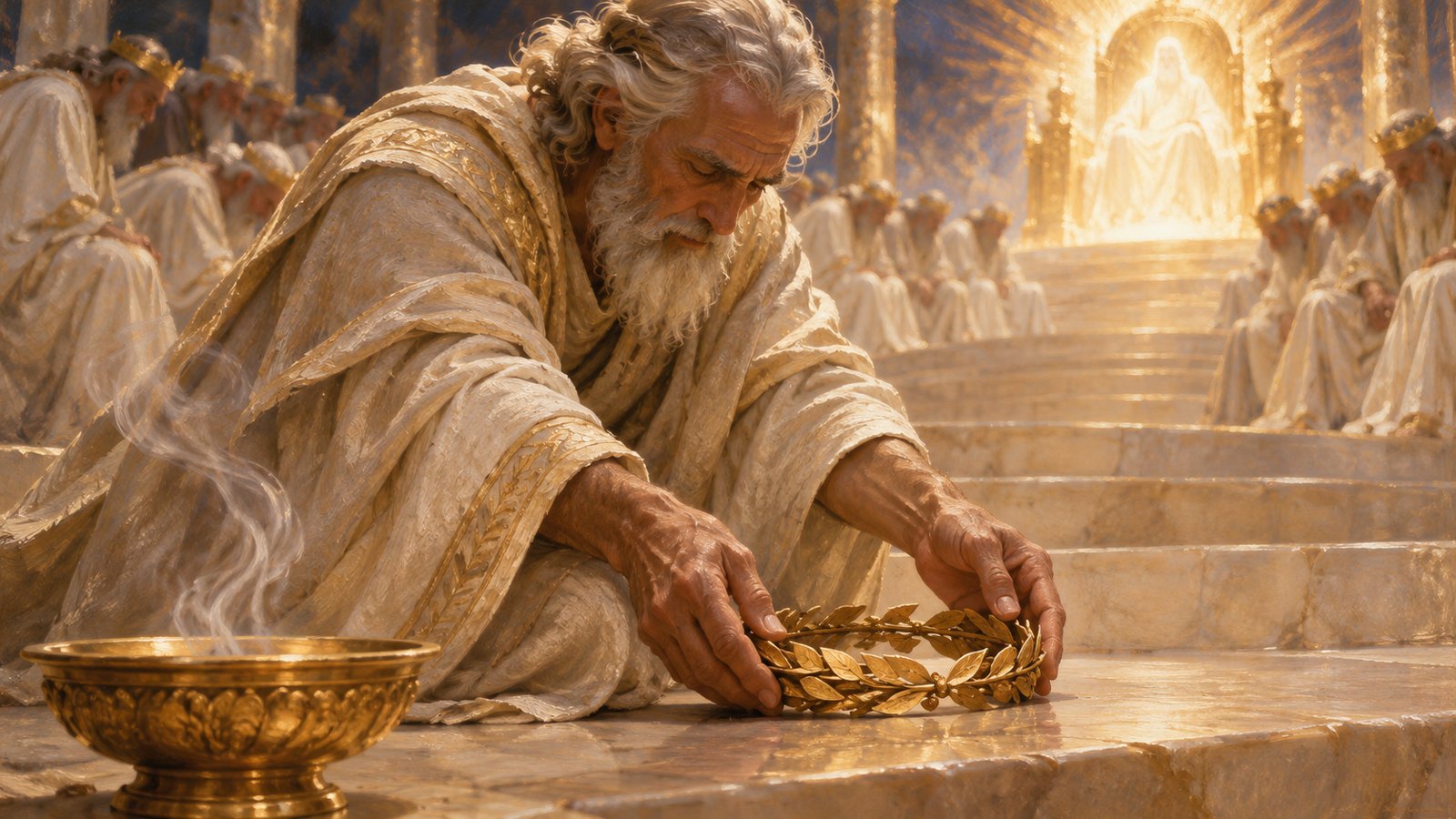
In Revelation 4:4, John sees twenty four elders seated on thrones around the throne of God. They are clothed in white and wear crowns of gold. One interpretation arrives at twenty four by adding the twelve patriarchs of Israel to the twelve apostles of the Lamb. Other readings identify the elders as believers already taken up in the rapture or as members of an angelic choir. Each must account for the particular company John describes. Why are there twenty four? Why do they hold harps and golden bowls of incense? Why does one of them know who has the right to open the sealed scroll? Revelation 4:4 · Revelation 5:5 to 10
The sanctuary of Israel supplies a single answer to those questions. The twenty four elders are the heavenly counterpart of the twenty four priestly divisions established under David. Their number identifies the order they represent. Their instruments and vessels identify its service. Their conduct when the Lamb takes the scroll reveals the limit of its authority.
II. The Davidic pattern of priestly administration
The twenty four priestly divisions. David, together with Zadok and Ahimelech, organized the sons of Aaron for service in the house of the Lord. Sixteen heads of families came from Eleazar and eight from Ithamar. The lots assigned each division its place, from Jehoiarib in the first course to Maaziah in the twenty fourth. Each head represented a priestly household. Together, the twenty four represented the whole order appointed to serve. David later entrusted Solomon with the plans for the sanctuary, its vessels, and the divisions charged with its work. 1 Chronicles 24:1 to 19 · 1 Chronicles 28:11 to 19
The harps and the golden bowls. The chapter immediately following the priestly list records a second arrangement of twenty four. David set apart the families of Asaph, Heman, and Jeduthun for music in the house of God. They served with harps, lyres, and cymbals, and their assignments likewise ran to a twenty fourth lot. Luke preserves the priestly side of the pattern in the account of Zechariah. He belonged to Abijah, the eighth division on David’s list. When his division was on duty, he entered the sanctuary to offer incense while the people prayed outside. John sees both ministries together. The elders sing with harps and hold golden bowls filled with incense, which he identifies as the prayers of the saints. 1 Chronicles 25:1 to 31 · Luke 1:5 to 11 · Revelation 5:8 to 10
The full assembly before God. On earth, a worshipper who came to pray on the day Zechariah offered incense would have encountered one division serving its appointed turn. John sees all twenty four elders seated together. The earthly rotation gives way in the vision to the full priestly administration assembled before the throne. When the question of the scroll is raised, every division is represented. Luke 1:8 to 10 · Revelation 4:4 · Revelation 5:1 to 5
Sign in to continue reading
Included for Supporter and Patron members, or unlock permanently for 5 Research Credits. The PDF is included.
FOR YOUR PERSONAL STUDY
Keep the complete paper
Download the illustrated PDF edition to read offline. Included with your access to this article.